IN PRAISE OF FRICTION (And Some Changing Digital Behaviors of Gen Zalpha)

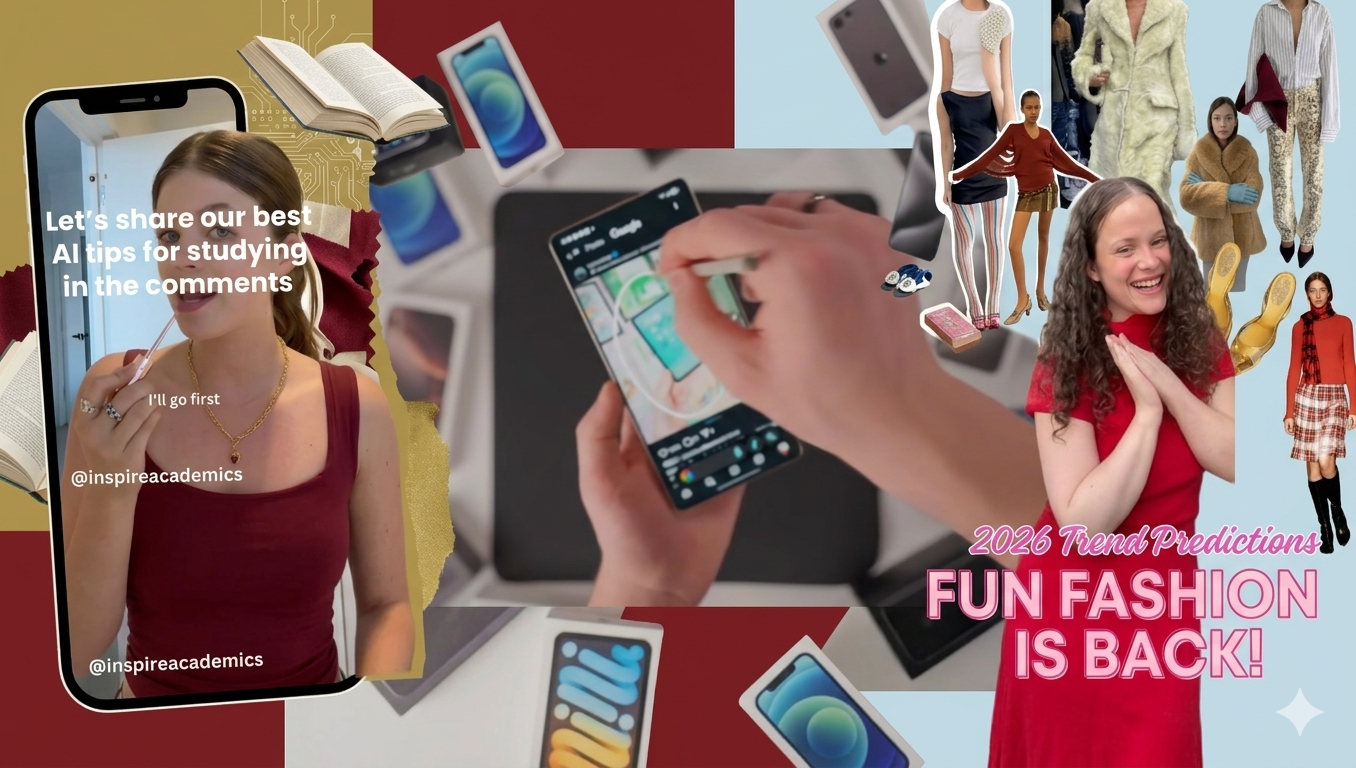
I've been watching a lot of YouTube and TikTok videos lately in which Gen Z influencers compare the merits of Apple vs Samsung, or Apple vs Google Pixel. It made me think of how consumer expectations around what their devices should be capable of in terms of information search and retrieval are changing.
It's not just that people are increasingly turning to AI chatbots for more complicated search queries, or that "AI summaries" are changing the landscape and economics of search, or that image-first search technology (like Google's Circle to Search) is on the rise. It's that, in this maturing digital ecosystem, there's a serious shift in how users – especially younger users – are discovering, finding, and processing information.
Search Stacks and Routing Logic
First things first: these observations are mainly based on US & UK consumer behavior, although there will be overlaps & parallels in other markets (Europe, APAC...).
Now, to return to the main show, as many have pointed out, yes, Gen Z and Gen α often search first on social media (TikTok, IG), especially for things like product discovery. A couple of years ago, the consensus of the commenting public was that traditional search was dead. People were freaking out that TikTok and Instagram were the top search engines for this demographic, while Google came in at a lowly third place. ALL ADVERTISERS SWITCH TO SOCIAL ONLY!!
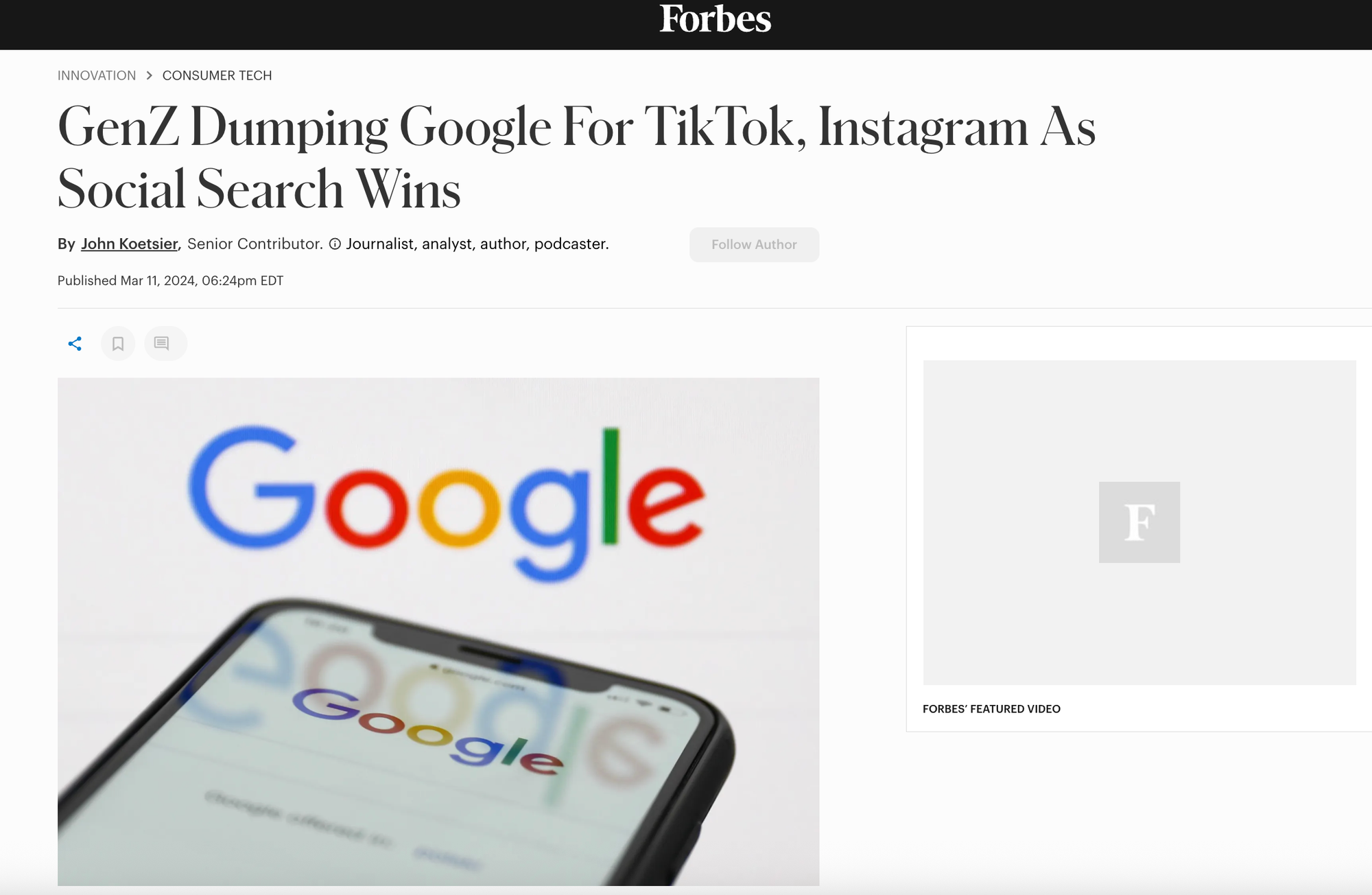
We now know it's a more nuanced picture.
Most users, including Gen Zalpha, have a search stack and routing logic for how they search for, discover, and process information. Meaning: users use different platforms depending on their intent and type of information sought. In other words, the routing logic to different platforms for search and information is determined by intent, rather than habit. This is what digital information fluency actually looks like for Gen Zalpha, whose search stack is starting to look something like the following: social media (TT, IG, YT) for lifestyle, vibes, product discovery; Google and Reddit for advice, information verification, and continued search (note: Reddit recently overtook TikTok in social media platform popularity among UK users, thanks partly to Gen Z); and AI agents like Claude, Chat GPT, and Gemini as, apparently, operating systems.
This has some interesting implications for Gen Zalpha behaviors (and probably many Millennials).
Total seamlessness is so 2000s. Long live friction!
People don't always want seamlessness. In fact, Gen Zalpha's search stack and routing logic has friction built into the system as a way of validating truth and calibrating for authenticity. There's a resistance to the one-stop-shop search bar which so revolutionized the search landscape when Google entered the scene and, by 2000, came to dominate over all other search engines.
Rising out of the erosion of trust in our saturated digital marketing landscape, and going hand-in-hand with younger consumers' increasing savvy about how to navigate said landscape, friction becomes a key part of the toolkit.
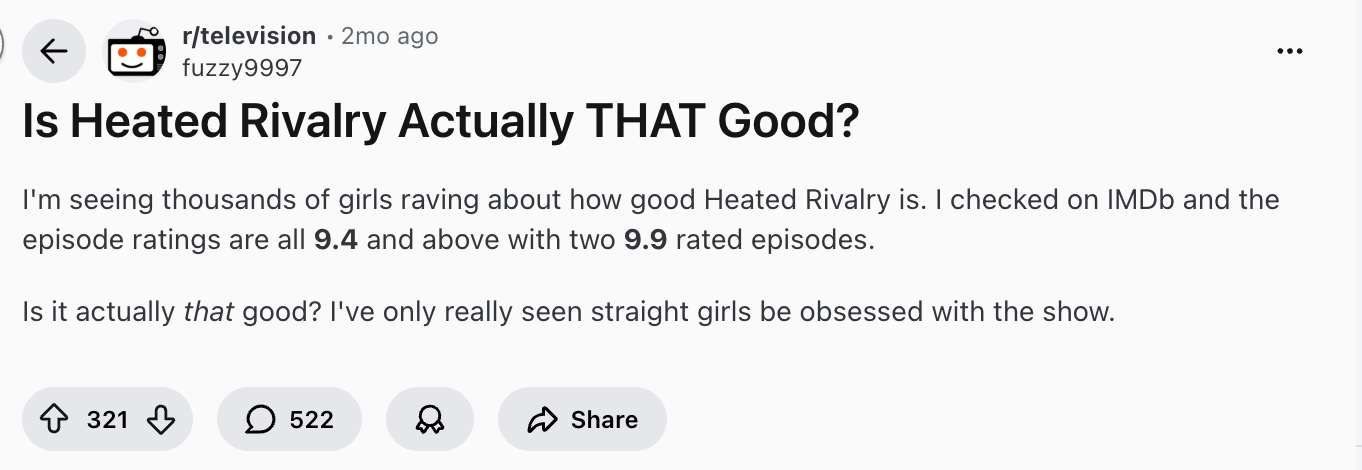
For instance: why is Reddit considered such a trustworthy go-to? Sure, it's got the "community" thing going for it, and this is often touted as part of the stickiness of the platform. But I have a slightly different theory about why we keep going back to Reddit again and again... and it's that the platform is actually full of friction. As a format, it forces the user to scroll through a long history of comments, trying to sift through what is true, what is not, what is funny, what is slop. I don't have access to Reddit user data, but I'd bet that at least half the time people go beyond simply reading the topmost, i.e. most upvoted reply; unlike your Google search hits. (I don't stop, at least; do you?) We're all there for the conversation.
Let me rephrase that: we're there for the friction-filled conversational turn-taking. Of all the popular social media platforms, Reddit probably exemplifies this more than the others (even, arguably, the platform formerly known as Twitter). There's something deeply comforting about scrolling through replies to a post, seeing multiple conversations unfold: someone throwing in a stupid-but-actually-funny dad-humor style wordplay joke halfway through the thread, someone else picking up the joke baton, agreement here, disagreement there, an asshole interjecting (then being taken to task), and it all ending with u/39jfa93txx asking, years later, somewhat lonesomely, "Hey, late to the party, but did that trick to fix your back actually work for you?" (Cf. Actual viral Reddit post about AI fixing someone's jaw.)
I suspect that what we crave is the friction of sensemaking. The process of sensemaking is fundamentally important to search and information processing – but in order to do that, friction is vital. Constructing a coherent picture from the noise, the sense of peeling back the onion, and the meandering journey that sensemaking entails. This is the delight of friction, and the reward of non-optimized search and discovery. It also feels constitutionally human to want to do this and to indulge in it.
Our sense of the “humanness”of a kind of sensemaking full of friction may be why people lost their minds when it was announced that AI agents already have their own Reddit-like social media platform, Moltbook. Released at the end of January 2026, Moltbook is a place where AI performatively sensemakes, where agents talk about and debate things like the nature of (their own) consciousness and the meaning of the relationship between themselves and their humans (as well as running commentary and debates about the nature of their labor). There is something deeply discomfiting about seeing agents, which are ostensibly programmed to run their sensemaking mainly in the background and serve up their curated cut of prime reasoning within seconds, enact this kind of human ritual.
Classification Galore
There’s another way in which the internet feels like it is cycling through a previous version of itself.
Remember this?
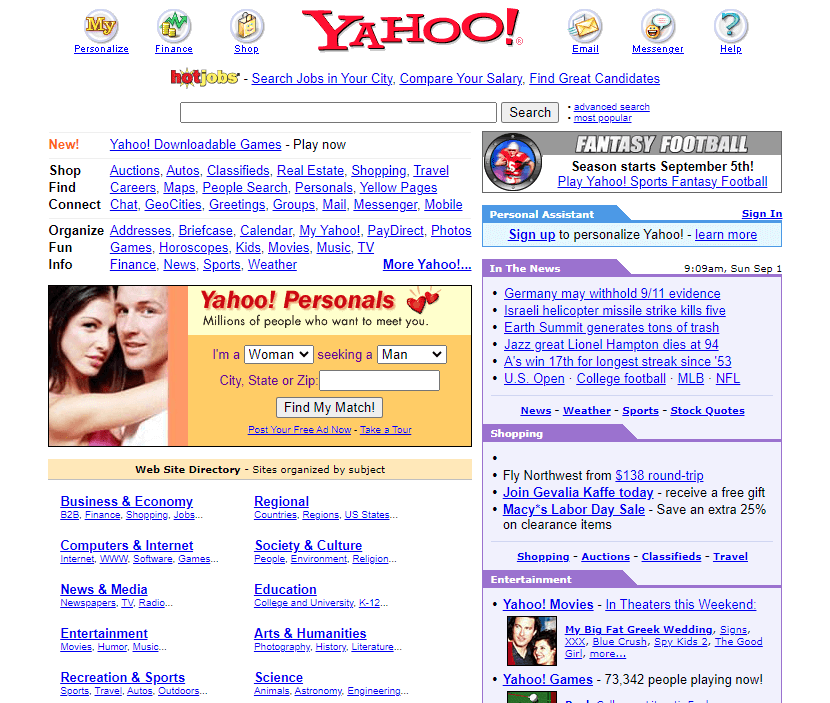
The increasing classification of the internet writ large into communities organized around topics of interest also recalls an era when search and discovery happened more in the way of this Yahoo! landing page, with its well defined categorizations: AUCTIONS, AUTOS, CLASSIFIEDS... NEWS & MEDIA, SOCIETY & CULTURE, SCIENCE. This kind of classification may no longer be on our landing pages, but it is deeply embedded in the ways we navigate around information from subreddits and Substacks to social media followings – more so today than ten or twenty years ago.
Are we moving towards a world in which our AI agents-cum-operating systems will be curating our "landing pages" for us in this kind of way, specially tailored to all our various and sundry interests? For most in the U.S., U.K., Europe, etc., the Yahoo! pages of yesteryear will feel busy and dated. In some parts of the world, like South Korea, where Naver reigns supreme, this is just how the internet has always been: highly categorized and classified, sub-sub-sub divided into endless communities of interest. Perhaps this is where we, too, are now heading.
What I'm reading/watching/consuming this week:
▶️ This paean to literacy and libraries on Aeon, arguing that literacy is really "the capacity to construct and navigate environments where understanding becomes possible." Parents, take note.
▶️ In case you've been endless scrolling on Netflix for something to watch...

Be rewarded.